Articles
Humans have a long tradition of holding genes responsible for individual differences in behavior (of course, we called it "blood", then, or "family"). In the 20th century, a counter-belief arose: that it was all down to environment, to upbringing. In more recent decades, we have become increasingly aware of how tightly and complexly genes and environment are entwined.
The more hyped and less plausible passive Mozart Effect
The so-called "Mozart effect" refers to two quite different phenomena. The one that has received the most media play concerns the almost magical (and mythical) effect of Mozart's music on intelligence. It is the result of a misrepresentation of the research results. Rauscher, Shaw, and Ky's 1993 study found that 10 minutes of exposure to Mozart's Sonata for Two Pianos in D Major K. 448 temporarily enhanced performance on three spatial reasoning tasks.
We all know that lack of sleep makes us more prone to attentional failures, more likely to make mistakes, makes new information harder to learn, old information harder to retrieve ... We all know that, right? And yet, so many of us still go to bed too late to get the sleep we need to function well. Of course, some of us go to sleep early enough, we just can’t get to sleep fast enough, or are prone to waking in the night. (Personally, I can count the times I’ve slept through the night without waking in the last fifteen years on my fingers).
A brief round-up of a few of the latest findings reinforcing the fact that academic achievement is not all about academic ability or skills.Most of these relate to the importance of social factors.
Improving social belonging improves GPA, well-being & health, in African-American students
Prevalence of dementia
Dementia is estimated1 to afflict over 35.5 million people worldwide -- this includes nearly 10 million people in Europe, nearly 4.4 million in North America, nearly 7 million in South and Southeast Asia, about 5.5 million in China and East Asia and about 3 million in Latin America.
Visual Language, a term introduced by Robert Horn, refers to "language based on tight integration of words and visual elements". The visual elements include shapes, as well as images (e.g., icons, clip art).
What does this have to do with memory? Well, partly of course, because the appropriate use of images usually makes information more memorable, but visual language has considerably more to offer than that. To appreciate what it is, Horn has examples at http://web.stanford.edu/~rhorn/
The two types of first-letter mnemonics
First-letter mnemonics are, as their name suggests, memory strategies that use the initial letters of words as aids to remembering. This can be an effective technique because initial letters are helpful retrieval cues, as anyone who has endeavored to remember something by mentally running through the letters of the alphabet can attest to.
There are two types of first-letter mnemonic:
Find out about the pegword mnemonic
Here are pegwords I've thought up in the Spanish language.
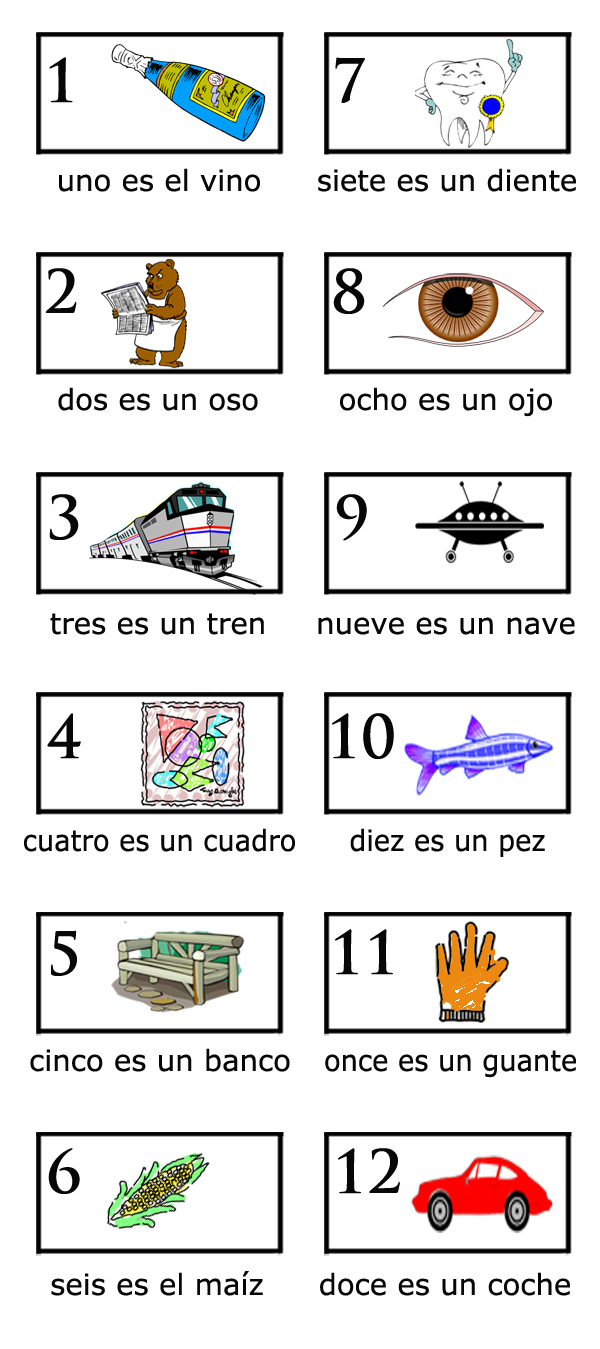
As with the original example, let's try it out with our cranial nerves.
En español, los nervios craneales son: